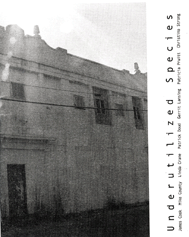
Underutilized Species
Poems by Cook, County, Crane, Doud, Lansing, Pruitt, Strong
James Cook, Editor
(Self-published for New Arts Festival, Gloucester)
2005
Last Friday night mostly Gloucester-based writers gathered for a poetry marathon that included Gerrit Lansing, Patricia Pruitt, Sara Stozer (reading work by the late Linda Crane), James Cook, Patrick Doud, Christina Strong and Mike County. The evening had been scheduled for the pier-side as part of the New Arts Festival, but because of rain, it was moved to the Universalist Unitarian Church. This is a serene edifice of severe, neo-Puritan design, which stands tall at the center of a half-block green and, as it sometimes happens in New England, towers over the cottage-like Episcopal chapel, its neighbor on the left.
Lansing started his reading at dusk. An aqua, milky shore light shone through two opened doors, one at street level to the right of the reader, the other on the second story, left-center, above. The visual then was of the poet in black at the chancel proscenium foregrounding a barren nave exteriorly lit by failing marine light from the doors above and right.
Perhaps in tribute to the occasion, Lansing introduced what seems a communal and fairly nostalgic analysis of Gloucester and things-Massachusetts as fixed topics for poetry. His is a straightforward depiction of the city and, in particular, the Atlantic surround "the pattern we are hung up on." In the poem "Blue Decrepit Town" Lansing notes first impressions from decades ago when, as a mid-westerner ("a heartland boy" as he puts it), he visited Gloucester while a Harvard undergrad. Lansing's impressions here do not advance beyond scene-setting notations, "nervous, / thinking of sex, / thinking of the ocean..." brushed against iconic counterpoints that cross over into tall tales, "a golden lion...grabbed by the throat of the mind...as song flickers."
By the time Patricia Pruitt stood up, only minutes after Lansing began, the street-level door turned onyx, while the second-story door shrank with dark, saline blues, leftovers from sunset. Against asymmetrical light fall Pruitt (who, like Christina Strong, is not from Gloucester) read other pieces than her poem in Underutilized Species, including one she said was "recently untitled" (or at least that is how I heard her describe it). Her published poem, "The Good Old Days," merges tributes to James Schuyler and Bay-Stater Fanny Howe, along with more mytho-reminiscing, "remembered looking into...a microscope, a telescope / And the third eye all at once." For a change of pace, Patrick Doud read multi-themed segments from a single manuscript called "Bomb." Doud wrestles with autumnal tones streaked with a North Shore sobriety -- "life reuniting with the whole. // The whole, which is death?" -- sometimes mixing more humorous colors -- "the policeman in the sky"; "me and the zombies of May." A sustained sequence of events and off-rhyme (phlox / Rock; prickery / Desperately) belie a poetics that is more buttoned-down than the title "Bomb" implies, but the venture, which reexamines the occult and other orthodoxies against "the pink // brightness of brain" appears more ambitious and more of a piece than a ten-minute selection might reveal.
Sara Stozer read poetry by Linda Crane, a deceased Gloucester poet who labored under the apparent influence of Charles Olson and natural imagery. I found it hard to follow these simple lyrics as other than denatured and derivative, given the subtitle, "in dogtown there is a constant spring" and lines such as, "the bird's head opens spilling / milkweed like our blood." In welcomed contrast, Mike County sketches patches of things kept at arms' length that turn out to be real nature poems, including one in memory, possibly, of that milkweed bird, titled "Robin": "Said to be a species...a trick / a deck of pinstripes shuffled... // Say the robin doesn't return? // Wonderful. I'll shell out the money / for wood to burn memory."
James Cook gave a surprising performance he tailored to be site-specific, reading from a manuscript he calls "Sugar Cane." I'm told he read these pieces concerning the "faceless" proletariat and political dictatorship in which "all men are servants," partly as "a knee to the groin" of New Art Festival organizers, protesting the $20 entrance fee for the night's reading ($10 for 'poets'). In an unforced voice that did not struggle to be de-modulated or otherwise separated from his text, Cook argued -- he subtitles his piece in Underutilized Species "(an argument concerning liberation)" -- the "all brown" guard who is "inside and outside ... sits. apart. he sits apart and looks out" over the cane workers and sugar fields within the painting and inside a "dialogue," both "fixed as in a book. a page you turn." Although the city and state are unnamed, layers of observed-observer complicity and servitude duly registered.
Just giving name to a place is a tad reductionist, that's what Christina Strong seemed to be saying, in response to the Festival and herself. That perplexing, dare-you gamin of Black Mountain-by-the-Sea, i.e., Gloucester, seemed awakened and fully alert as Strong read poems about poetry, against the sociopolitical stranglehold of the "narrow as we say conservative." Her poems fell atonally like wee bricks of Somerville sensamilla (a rare species) spinning pollen over the fertile runnels and dark pews of Universalist Unitarian. Hers were the only poems off-narrative, but they made perfect 'sense' if by sense we mean they are more than a little tormented as they comment on the moment, on limits of poetry, even while coincidentally picking up others' themes: "...wander beach and all these / fucking pictures, question of pay out or cash inn / name place zombie all the time." Her poem in Underutilized Species, "mr super stupid head," speaks as a primer on what to hate in youthful composition, "catalogue group / or specify trickster... // relaxed that this justifies that... / or hem tone to be as that just / throw up or puke the etymology of / pathos." I just had to laugh. In a UU church.