Alan Davies and Tony Towle at the Project, Feb. 8. For 30 years or more Alan has been a stickler, deciphering and telling the truth (as he sees it), and in introducing his reading Alan sent up a well-earned and inarguably well-timed, collective sigh-cum-plea-cum-complaint with respect to deplorable public discourse we surround ourselves with, discourse, he says, that "has been obliterated in front of our eyes." His intro was fair warning of the sobriety that ensued. He read a work titled (for now) "book 4," which he completed in 2003, fourth in a series of 30-to-60-page books that function as one long, variegated poem.  Not obvious from his delivery, Alan's text is composed in short line fragments. The narrative, however, does not always fragment along similar lines -- for example: "loneliness always lasts so long / the simple day at a time succulence of sex in time;" or, "for you you / for another another / and then some." These lines illustrate a formal dissonance I experience, syntax that is mindfully flat and conventional, but a lineation and scansion, along with repetition, that suggest more emotion than a level head bowing to convention might predict. Alan sticks with this formal dissonance, establishing a wobbly equilibrium for imagistic mixtures, the fantastic and the ordinary. Alan speaks of some lady of the lake who's partially there, "she levitates above the lake ... the underarms / the river and the lake / the unmade bed," etc. Alan's themes are pronounced, time, age, loneliness in not fully having that lady, but also there are clues for other things less dire, a humane and even comic doubleness of ardor and numbness, of fervor that taints ("finding it kind of tiring"), of the mind "basted" ("a terrible thing"). Straightforward, yet fragmentary and 'poetic' qualities of Alan's composition serve as antidotes to 'obliteration' of the language, for sure. Yet, if his long poem of many books continues, I look forward to volumes filled with more truth telling of this doubleness sort.
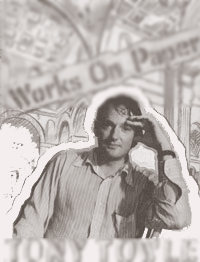
Tony Towle has been up to his game, games, really, for more than 40 years. Tony is the perpetual liberal arts practitioner, flush with a generalist appetite and boned-up erudition that takes on immaculate precision in endless satire. He reads history and art criticism and inserts points of fact (or near-fact) and opinion as hysterical asides for poetry, sometimes for pages at a clip; he checks geographical data, and enters these, too, as the basis for grounding wee bouts of surrealism, which, as we know, is a poet's trick discipline reflective not so much of erudition as of fancy booting factual and imagined in the mind, so, so, yes, geography, by all means. 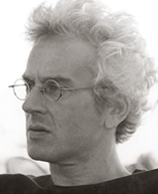 Reading and achieving laughs from early, middle-period, and more recently published works, as well as several unpublished pieces (or what he calls his "disorganized codex"), Tony's brief laid down sporting predicates, nothing's changed terribly, we're all older, the umpires keep making mistakes. Part of the game is the asides outside the poems read: Tony's shock to learn from Joe LeSeur's memoir that Joe didn't like him; Tony retelling the time Jack Kerouac heckled Frank O'Hara off a stage, and Frank turning to Tony, half-tearfully, "It's ok, my silence is more interesting than his bullshit." In the unpublished pieces, Tony deals with aging and loss unruefully with a comedic and light hand, "by the time I got to the end of the sentence, she was gone." In a series titled "Truth in Advertising" Tony brutally inscribes what the screen displays, "tacky enthusiasm over a credit card"; a snowman in a scarf pushed into clothes drier, saved and done in imbibing "snow-making fluid." I'm sure there are allegorical essences in fluid that saves a snowman but renders his bones too cold to touch. More interesting is Tony's ability here and over 40 years to evoke hoots and some pathos from everyday felt experience, or what some would like us to feel everyday, this time a truth in advertising, 30 seconds at a clip.
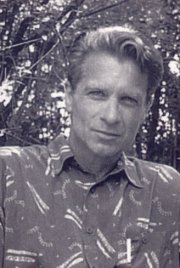 In brief, Michael knows the fast (and sometimes the only) roads out of delusion, language research; that research ink-marks the "pluggy" ways to newly drilled tunnels beneath congested interstates and, more, the sturdiest reconstructions of escape routes through "built down audibles" that seem "wide as sleep" with "my nose in a book..." right here in "the academy of false hopes." Michael read from No Both, My Terza Rima, as well as unpublished pieces, some of whose titles give up their no-nonsense enigma with an oversupply of confidence, "effrontery ... as a branch of knowledge": "In Case of Memory"; "I'm Not There"; and a favorite, "Life Boat Days." Michael is after Ashbery in that last title, but it's tribute in the service of blues "the sun misrules" as the "weather set us apart." My notes on the poem "In Case of Memory" conclude, "the world is enormous, and then we left the house...no closer to stars than closer together."
 Marshall Reese and Gary Sullivan at Segue, Feb. 4. First, this was hyper comedy and a brilliant pairing -- big thanks due curator Mitch Highfill for bringing Reese and Sullivan together. Most readers here know or know of Gary, but unless you've developed a taste for some specific intersection of video installation and poli-conceptualism, Reese may not be familiar. Frequent collaborator with Nora Ligorano, Reese's constructs pick up on the criminal demeanors and other lame qualities (there are many) of conservative operatives, captured nicely in his and Ligorano's Contract with America Underwear over which Newt Gingrich's "Contract" is emblazoned, along with Gingrich's bulging likeness on the crotch. The satire is obvious and, well, touching when you consider how profound our need is for any humanizing palliative to the super order of desensitizing and flat out deceit our normal daily interactions are subjected to.
  Impulses in Reese's poems are connected to his graphic pieces. His lines frequently refer to them and to an artist's perspective, the need to "reform the narrative" infuse it with "visual" optimism that might reflect his artwork ethic, "scrap iron knitting together a bagatelle [that's] somehow visual," or more Anthony Braxton-like, painting with sound, "returning to found objects … logic in brick red." According to Reese, "you are mis-identified," because of "mis-data" and "imprecision." To fix this Reese toyed with some computer voiced over duets, but I liked his otherwise straightforward deadpan delivery from "witless boundaries," as he puts it. The funniest poem concerned the Speaker of the House and new majority leader (and the whip!) with the repetition of "I want to do you" cheering the audience, mightily.
  Hold on, Gary's phone message-tree is playing to this crowd of poets but who else would be at Segue on Saturday afternoon? So the laughs come up from everyone's ankles, through the abdomen and they are not going to stop, a doodle about Olson studies (they're back in style, kinda), a hamster-as-president four-liner that blames disjunctive poetry for "weird shit" coming down, a poem-script between John Dewey and Jenny [sic] Olin[?] -- a Dewey and Jenny duo, anyway, and played-read to falsified affects by Sharon Mesmer and Jimmy Behrle -- and another titled "Plop Takes" that instructs the senses thus, "Stink lines with flies. Perfectly coiled turds." GS sang, as well, a poli-sci blockbuster, "Bruce," which sounded to me like a total translation of maudlin white rock into toothy groans and prickly irrelevance -- toothiness, let's call it. Call Gary a funny, heroically untrained anthropologist. Gary gives good bite.