 Monumentality
 is a silly environs for hobos at a point of time when esthetics are pitched to viable contexts über intimacies and other intentions. For humorists, the monumental is a free radical to chew out or evade, tactically. Macgregor Card tries something comedically different in
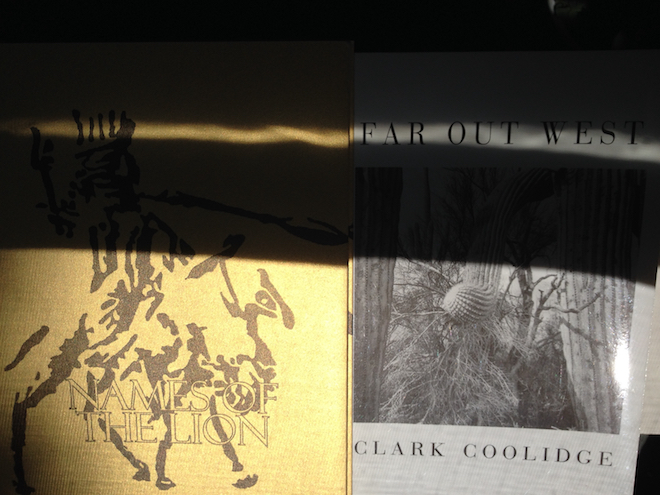
Souvenir Winner (2002, Hophophop Press), a collection of nine short verses (“verses” is the term) that carry on about themselves (of course), also about “mother,” “Pauline,” and other family relations among immortal lonely hearts out there where “teeth soak of their own accord” and “fluency is the chart of an architect / eyeballing space, and the chart, a poet’s diplom’.”
Card dedicates Souvenir Winner, tellingly, formally, to Alexander Scriabin and Achilles Rizzoli. Scriabin is felt at the surface, emphatic grammar shifts, as well as tonal splinters, compressed harmonics that distinguish archaic, antic mergers of “footman,” “Christ,” and “a porpoise in a pretty tune.” Yet Rizzoli is the principal lonesome foggy and recurring motif for Card’s ultimately upbeat romp through stencilled space. Rizzoli, an architectural draftsman who lived in mid-20th-century San Francisco, is appreciated today for oversized Beaux Arts renderings of Kathedrals, huge symbolic portraits, and other big-scale pieces crammed with odd poetry, anagrams and fake quotations often translated into a secret code of his own. Bona fide ‘outsider’ monumentalist, Rizzoli is the architect of choice for Card to chart with. Also on.
*
Card’s reworking Rizzoli parallels John Ashbery’s
Girls on the Run, a storybook in verse about small fry linked loosely to Henry Darger, another outsider and monumentalist who authored an illustrated novel of over 15,000 pages,
The Story of the Vivian Girls, in What Is Known as the Realms of the Unreal, of the Glandeco-Angelinnian War Storm, Caused by the Child Slave Rebellion. But Ashbery’s and Card’s strategies for adaptation are different. Ashbery’s freely descriptive and much longer chronicle draws on Darger as “only a jump-off point,” Forrest Gander suggests; whereas Card’s diminutive lyrics substitute fruitful accidents and nonsequiturs as supportive elements of cohesive story telling. In attempting to complement Rizzoli’s visual spectacles, Card’s is the more exfoliated imagery, revitalizing a belated Beaux Arts consciousness that Rizzoli himself describes as one “hermetically sealed spherical inalienable maze of light and sound seeing imagery expand in every direction.”
Some people that are sick are not people.
They are hereditary balls of light
This begins verse “VIII” in
Souvenir Winner, a twenty-line schizophrenic paean to oracular irony where distinctions among metaphor and simile, cause and effect, eye and I, object and subject vaporize into “the souvenir / of flung windows.” We begin again, instructed that some of the sick are not people, but “balls of light” as the poem continues:
like the tallest man in the world
must be lonely looking
no one in the eye all the time.
I couldn’t seem to move, Pauline,
the famous men from stars to tears ...
‘The tall guy, one of those lonely stars, is a fire ball I can’t move. I can’t make him come sob down here, that is, even as I think you up, I can neither see nor move myself or you, Pauline, I feel sick.’ To accede to this logic is to be possessed of an oceanic albeit menacing enchantment that, in my case, wakens long-sublimated, communal attributes of a once-content childhood, one given to perfecting a petulant naiveté, and one resonant, I suspect, with affects on Card of Rizzoli’s life and work.
The impression that Rizzoli serves as a running motif is reinforced by the inclusion of three of Rizzoli’s designs, it seems, as well as swatches of quotes from his supposed prose, slogans and working titles. Still, Card upends the initial impact of a one-on-one appropriation as collaborative transaction. In epigraphs, text annotations, and especially his “Notes” that follow the nine poems, Card discloses how he supplements Rizzoli by lifting text or ideas from a range of better known sources, including the New Testament, Lord Byron and John D. Rockerfeller, Jr., and by inserting fragments from a number of inscriptions on public buildings in New York. Not all these borrowings are straightforward, though. In the ninth and final verse, Card miscues the reception for the opening four lines by referencing a biblical passage in italics just below and to the right of line four. The passage is Paul’s
Romans, Chapter 12, Verses 3-8. In the King James version it starts, “For even as we have many members in one body...so we the many are one body in Christ, and each one members of one another ...” Here are the opening lines to Card’s verse:
My roof is done like a faun into tears.
Never seen despite all its rich article.
A fairy wand in a court of law, twittering, faultless,
Mute, staked as a mare to a formal lawn.
Card rocks the sweeping, representational register of the referenced text (we, members, one body, Christ) into utter reversals of Paulist dogma: fugitive simile and Gnostic incongruity (roof like a faun, fairy wand), through which glints of representation shine, only briefly, like waning metonyms both “twittering” and “faultless.”
Card exposes a baseline ambition later in the poem:
Tell the good old lowering eyes – broad feet
toward the door – I’m a poet, showdog
rightly termed dreamer, skaters on blockheads,
scented peers. “I have only one plate of soup.”
Card bludgeons Paul’s certainties (sitting targets, admittedly): “we have many members” is taken down several notches by “I’m a poet, showdog”; “one body” melts into “one plate of soup.” For the showdog, inferential exactitude is an on- or off-affair. As for his reference to the biblical passage, Card reveals in conversation that the intent is to have Paul’s
Romans “echo” within his poem, without direct quotation.
The good question to pose at this point is, why bother to take on Paul,
Romans, and such? My hunch is – and it’s a fairly sure bet – architectonic voices in Card’s head encouraged his ambition. Churchy texts and artifacts by Rizzoli motivate Card’s lyric, as in Card’s volunteering citations of Rizzoli at the end of “V. Yield to Total Elation”:
We are almost tempted to call him sweetheart.
The light that made Jesus speak through a sonnet.
If Rizzoli plays with matches, Card yells ‘fire’ and catches hell.
... I’m a poet, showdog
rightly termed dreamer, skaters on blockheads,
scented peers. “I have only one plate of soup.”
How much will you need? “A cupful of tears.”
Echoes? Card calls out the name Paul or Pauline over a dozen times in the nine verses, and refers to Rome or Romans six times. For good measure (and ghostly after-affects), the passage from Romans referenced in the final poem is ascribed historically to Paul. While Paul’s text has been in effect erased, key lexical items are distributed throughout
Souvenir Winner – God, Christ, love, grace – as well as close paraphrases: Paul’s admonition, “not minding high things, but yielding to the lowly,” is mirrored by Card in “a debt / of honor paid for in plain fact, humility.” Card’s “My arm’s an idler’s rod inveighed against genius” can be traced to Paul’s “Do not be wise within yourselves.”
*
Echoes happen within architectural plans that afford vast interior space to exceed normal acoustical barriers. Cathedrals come to mind, certainly to Rizzoli’s mind. Card has examined Rizzoli’s drawings and writings on Kathedrals at length, and then in his “Notes” Card gives evidence of his search for inspiration in other Beaux Arts structures, such as banks and post offices in Manhattan and Brooklyn. An impression I have is of a poet so on the verge of elaborated ceremony he plunges into it physically and over time, a process-under-the-influence that might appear to some as extraordinary or even wreckless.
I love mourning on Earth,
decorating my fortune wheel.
Card’s architectural immersion is reflected in his formalist textual structures, as well. A quick scan of the verses shows colonnade-like symmetries: even-numbered poems (the mossy shades between columns?) are numbered but otherwise left untitled and each winds up with a 5- or 6-line coda; odd-numbered poems (the columns?) are numbered and titled after coinages ascribed to Rizzoli, and each odd-numbered poem consists of three stanzas, whose middle part can contain any even number of lines from 10 to 20, but whose beginnings and endings are always four lines. For example:
Earth is light, but mother weighs less
on the surface of my poems than on mars.
Her habitat’s the top-drawer aurora
the sorrowful bell tunes are built in.
Souvenir Winner is grandstanding about itself as poetry,
mysterium profundum, and ostentatious paradox rhymed with a vocabulary of romance, dreamy totality and unfashionable gods. Its Beaux Arts pedigree requires nothing less. In aftermath, its fire ball wit blazes, even when doused with hope.
So wrest the dough of toll from me.
A lot is sad, but the habitat’s a fine place to be.
We’ll intuit a city-intimate ray – you and me
and the other ones ...
*
Macgregor Card’s voices — architectonic, effusive, genial in 2002 — echo in 5 Poems (2009). [
www.poetryproject.org/5-poems-by-macgregor-card/]. This music is of another ceremony / totality, a bit like watching how Rizzoli’s “seeing imagery expand in every direction” piles it on plaintively.
“The Merman’s Gift / for Karen Weiser” begins “Brother I need back my sticks...” Merman, a fantastic character, wants everything back for real, calling his gift “sticks ... I hope they bring us closer now,” so close (the self) caller and response giver (the self) are conjoined in off-rhyme —
to range / by grass depressed by possibility alone
One and every /actionable blade of glamor
in a ranger’s vatic underfauna / If we go there
I’m a total wreck my brother / carried off at totalcy
I need for you to wreck / upon yourself
the salvage you recover / from me
and I love you / I need back the sticks I loaned you
— in 80 lines echoing “sticks” give voices to “totalcy,” a normal if vatic monumentality to be attained and released (given back), an entire round. “What is there to sing but a round?” Card asks in “To Friend-Tree of Counted Days,” another of the 5 Poems. Here sticks are branches helping Card “climbing a tree / too high for words / whose leaves are as green.” We’re in another call and response, mystery place; “to range”
I can only imagine
is probably astounding
if seen in generous light